
Civil society groups and citizens from the Sebei community have formally petitioned Parliament, calling for the withdrawal of the proposed Protection of Sovereignty Bill, 2026, citing constitutional, economic, and governance concerns.
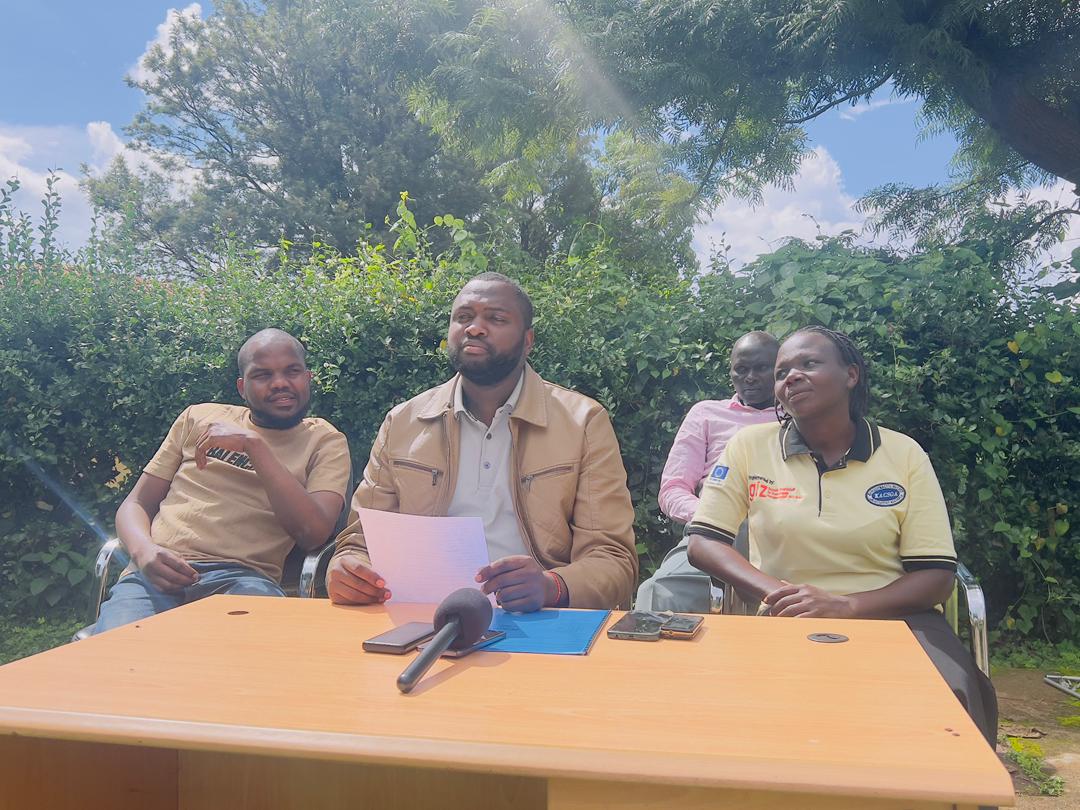
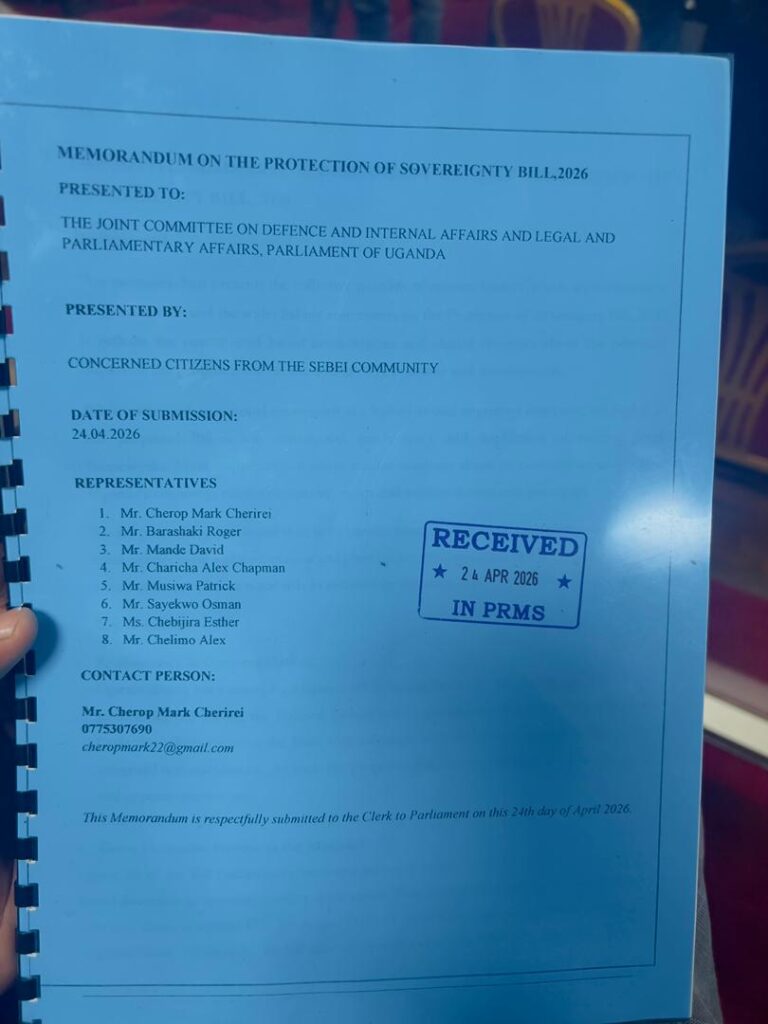
During a Press Conference yesterday at Kapchorwa yesterday, Mr. Cherop Mark Cheririrei the Program associate at Kapchorwa Civil Society Organization’s Alliance (KACSOA) A network organization for NGOs and CBOs operation in Sebei Sub-region informed the press that the memorandum, submitted on April 24, 2026, to the Joint Committee on Defence and Internal Affairs and Legal and Parliamentary Affairs of the Parliament of Uganda, reflects the collective views of civil society actors, opinion leaders, youth representatives, religious leaders and members of the wider Sabiny community.
Mr.Mark Cherop, the Program Coordinator of the Kapchorwa Civil Society Organizations Alliance (KACSOA) said the proposed Protection of Sovereignty Bill 2026 is unnecessary because existing laws already provide adequate mechanisms to regulate foreign influence and protect national interests.
Cherop cited the NGO Act (2016) the Anti-Money Laundering Act (2013) and the Political Parties and Organisations Act as sufficient legal frameworks that address the concerns the Bill seeks to tackle.
He also raised concerns over provisions in the Bill that allegedly grant excessive powers to the Minister, particularly in approving or rejecting applications without clear timelines.
“Clause 20 concentrates excessive powers in the hands of the Minister, granting him broad discretion on whether to approve or reject applications without clear timelines,” Cherop said.
He further argued that ordinary Ugandans receiving money from relatives abroad could face unnecessary bureaucratic approval processes.
“We are looking at a situation where receiving money from a relative abroad could be subjected to approval or disapproval from the Minister before it is used,” he added.
Cherop also criticized what the group described as an “unconstitutional assault on citizenship.” According to him, Clause 1 of the Bill seeks to reclassify Ugandan citizens living abroad as foreigners, contradicting Article 10 of the 1995 Constitution of Uganda, which guarantees citizenship by birth.
He warned that such provisions could negatively affect diaspora remittances that support many households in Sebei.
“Sebei has for a very long time produced outstanding long-distance athletes who, because of poor training facilities, are forced to go as far as Kenya for training. According to this Bill, that would mean such athletes are deemed ‘foreigners’ and their relatives ‘agents’ of foreigners,” Cherop said.he added that Sebei is the food basket of Uganda and other 80% of the tractors and used by Sebei are from kenya and the bill will affect farming and some people in the border are polygamous and have families and this bill will make life hard for them.
The petitioners also argued that parts of the Bill could criminalize democratic participation by restricting alternative policy proposals and limiting the role of opposition actors and civil society organizations.
They further expressed concern over harsh penalties tied to loosely defined offences such as “economic sabotage,” warning that the provisions could discourage investment and threaten academic and media freedom.
However, in a twist of events, President Yoweri Museveni has distanced himself from the version of the Bill currently before Parliament.
Government has also reportedly narrowed the definition of a “foreign agent” to exclude Ugandan citizens from being classified as foreigners. Instead, the revised definition describes a foreign agent as a person acting on behalf of a foreigner, under their direction or control, while receiving financing or subsidies from them.
In conclusion, civil society actors and citizens from Sebei have called for the immediate withdrawal of the Protection of Sovereignty Bill, 2026, in its current form, arguing that it poses significant risks to constitutional rights, democratic governance, and economic stability.