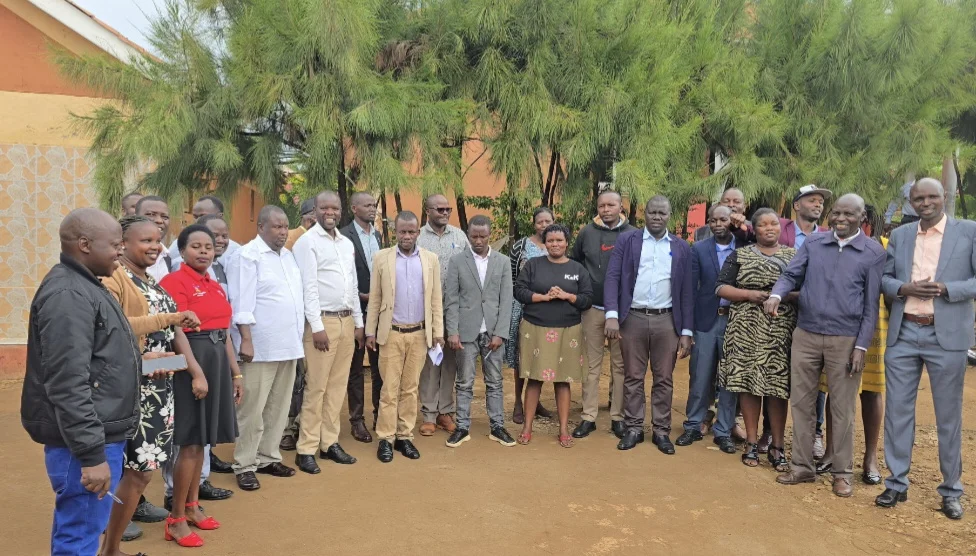
Citizens in Sebei have called on Members of Parliament to reject the proposed Protection of Sovereignty Bill, 2026, citing concerns over its broad provisions and potential impact on civic space.
They argue that the bill, which is reportedly anchored on Article 1 of Uganda’s Constitution, gives sweeping powers to authorities by broadly defining a “foreigner” to include not only non-Ugandans, but also Ugandans outside the country, foreign governments, NGOs, companies, and any entity the Minister may designate.
During a joint press briefing, Mark Cherop, KACSOA’s program coordinator said “the protection sovereignty bill 2026 represents a calculated effort to dismantle the constitutional safe guards that protect individual liberties and participatory governance replacing collective governance with unchecked, centralized authority”.
Cherop further called on MPs to exercise their oversight mandate and stand with the people, to reject any legislation that criminalizes remittances, family support, and the fundamental rights of Ugandans.
The bill further states that receiving or handling funds linked to foreign entities, influencing public opinion on government programmes, or engaging in political activities tied to foreign interests could attract penalties.
Civil society actors warn that the penalties are severe, with individuals facing fines of up to UGX 2 billion or 20 years in prison, while companies could be fined up to UGX 4 billion.
Festo Majinjach, the Program Coordinator at Sabiny Transformation Initiative (STI) raised concern over clauses that would require government approval for certain activities, limit foreign funding to a capped amount annually, and allow the state to confiscate excess funds.
He said “78% of Uganda’s population is under 40 years who get their support from foreign remittances from Ugandans, NGOs and the church that offer education, heealth care, livelihoods, food, as well as running orphanages” urging MPs to reject this bill because “it is not good for Uganda”.
Bishop Martin Chelangat who represented the church expressed concern over the proposed bill on the church and its international relations most of which support various activities in the church and their communities.
He said “many churches across Africa rely heavily on cross-border networks for their survival. 90% of the tractors were using in Sebei are from Kenya, the sovereignty bill is going to negatively impact on agriculture and livelihoods and put religious institutions in an awkward position.”
Citizens say the bill could have far-reaching implications, potentially criminalizing legitimate work by NGOs, restricting academic and policy discussions, and limiting community initiatives supported by international partners. Charicha ABC, a Senior Citizen said “the proposed Sovereignty Bill poses a serious threat to social service delivery and overall development”.
Citizens are now urging legislators to critically review and reject the bill in its current form, warning that its implementation could undermine fundamental freedoms and disrupt development efforts in the region and beyond.
Femier Chelimo, Project officer at FIDA Uganda, said “we need work closely with MPs because this bill is going to criminalize us the citizens, of course, we will not be able to hold the government accountable. If we talk about how health centers, schools running, we will be criminalized” further criticizing the bill.
The bill, presented for first reading by State Minister for Internal affairs, General David Muhoozi on Wednesday, April 15, 2026, seeks to regulate how individuals, companies and organizations receive money or assistance from foreign sources.